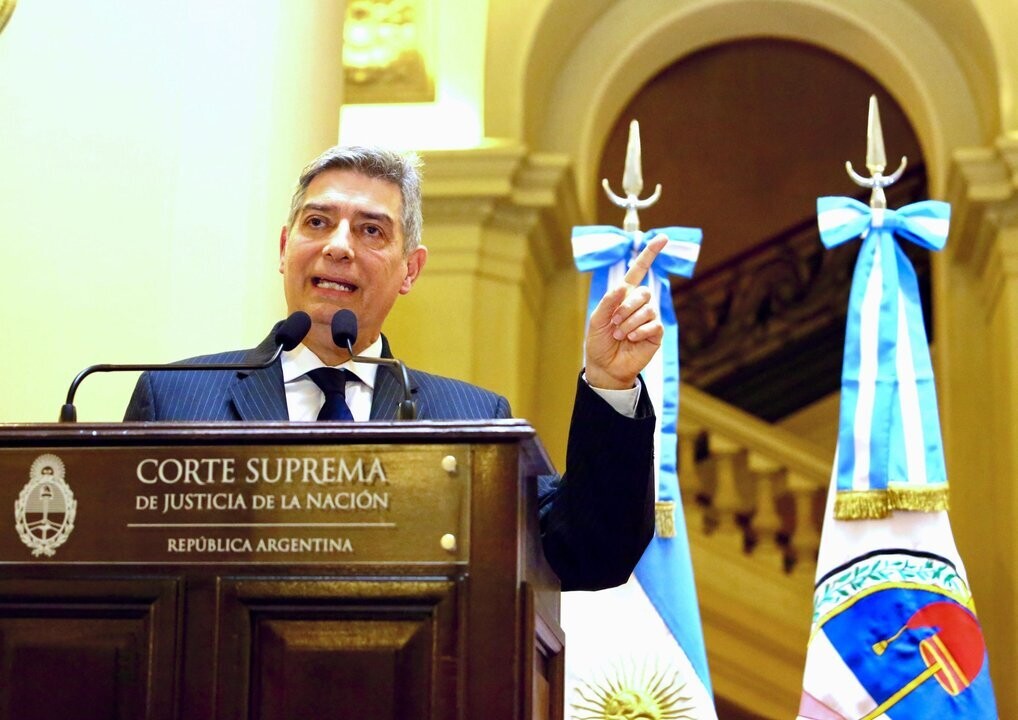
The President of the Supreme Court, Horacio Rosatti, stated that the uncontrolled issuance of currency without real backing is also against the Constitution, analyzing the legal limits of a potential dollarization of the Argentine economy. Rosatti explained that currency serves as a medium of exchange, a unit of account, and a store of value, and argued that Argentina 'cannot have a single currency that is foreign' because it cannot issue, mint, or set its value, which 'is prohibited by the Constitution.' The magistrate recalled that the Magna Carta obliges to 'defend the value of the currency,' which implies a relationship between the monetary base and reserves, and warned that increasing the supply of pesos without backing 'decreases the intrinsic value' of the national currency. Rosatti noted that dollarization can be used as a reference or store of value, but highlighted that the experience of convertibility showed the limits of pegging the peso to a 'much larger and more prosperous' economy like that of the United States. 'What the Argentine currency can do is compare itself to another currency, as happened in convertibility,' he indicated, although he emphasized that this parity is not reversible and that Argentina 'cannot regulate the value' of foreign currencies such as the dollar or the real. When asked if his public warnings against dollarization influenced the current government's shift towards strengthening the peso, he replied that it would be 'presumptuous' to think so and asserted that 'the Constitution is what rules,' beyond any political message. 'The only thing I focus on is the Constitution and the laws,' emphasized the head of the highest court, when asked if President Javier Milei had communicated any position regarding his criticisms of dollarization. Rosatti assured, during an extensive interview with Perfil, that his relationship with the heads of state he served with in the Court — Mauricio Macri, Alberto Fernández, and Javier Milei — was 'practically nil' and stressed that none of them called him 'about the fate of a file.' 'The fact that Macri regretted my appointment in his book speaks well of him and well of me, because it shows that I was not proposed to say yes to everything,' the judge said. Argentine News Agency. Regarding the confirmation of the conviction of former President Cristina Kirchner in the Vialidad case, Rosatti said that he ended the day with the feeling of having 'fulfilled his duty,' although he admitted that judges sometimes sign sentences that 'torment' them for a long time. As an example, he mentioned a ruling in which the Court declared the statute of limitations on the conviction of a priest accused of abuse against minors, which allowed his release despite the facts being proven, and described the tension between 'doing what is right' and what dictates moral conscience. The head of the Court avoided detailed comments on the Cuadernos case because, he said, it will probably reach the court, but compared its potential relevance to the Trial of the Juntas and Brazil's Lava Jato, in case of firm convictions and asset recovery. Regarding the debate on 'collaboration,' he argued that judges are governed by 'sound criticism' and that an initially insufficient piece of evidence can be supplemented by other elements, although he distinguished this scenario from evidence obtained illicitly, such as hidden cameras. In line with this, he recalled the doctrine of the 'fruit of the poisoned tree' and explained that traditional liberal criminal law rejects using evidence obtained without legal backing, although the discussion was revived when these elements serve as an indication to obtain valid evidence. Rosatti admitted that there is an additional tension when journalism disseminates relevant information obtained irregularly, for example from reports with fugitives, and judges must assess the legal value of these materials in criminal cases. When referring to Decree of Necessity and Urgency 70/2023, he emphasized that the Constitution sets a procedure that includes treatment in the Bicameral Commission and in both chambers, and noted that 'that process has not finished,' so the Court decided to wait for the Congress's definition, as learned by the Argentine News Agency. He recalled that some chapters of the DNU have already been suspended or amended by other laws and illustrated that what began as an 'omnibus' has turned into 'several traffics,' with different judicial and legislative destinations depending on the content of each article. The magistrate maintained that the control of constitutionality in Argentina is 'diffuse,' which means that 'any judge' can declare the unconstitutionality of a norm, and that the Court acts as a unifying vertex, which delays the consolidation of criteria. When asked about the possibility of the Supreme Court's rulings being binding for all courts, he recalled that the 1949 Constitution established this explicitly, while the text in force since 1957 is 'indefinite' and does not set that binding nature. He clarified that the Congress could try to pass a law making the Court's rulings binding, but warned that such a norm would end up being reviewed by the Court itself, which would have to decide whether it is constitutional or not. Rosatti revealed that '60 percent' of the cases the Court deals with come from the State in the social security area, where the highest court 'always says the same,' and considered that a system of binding rulings would drastically reduce that burden. As for the composition of the Supreme Court, he affirmed that the 'historical' ideal number is five members and rejected that the integration be balanced by legal specialties or by territorial representation, since the latter 'is in the Senate, not in the Court.' 'To be a minister of the Court, one must know constitutional law, that is the most important thing,' the judge stated, who ironized that, if they wanted a representative for each branch of law, they could end up being 'as many as there are letters in the alphabet.' The president of the Court acknowledged that he misses the contribution of former minister Juan Carlos Maqueda, whom he defined as an official with 'rarely seen institutional experience,' for having passed through the three levels of government and the three branches of the State. At the same time, he admitted that with three members the Court issues more rulings than when it had four or five, because the majority is reached in a single round of votes and the judges make an 'effort' to agree on unique texts. Regarding the absence of women since Elena Highton de Nolasco's departure, he avoided deep pronouncements by stating that the Court has pending cases where this discussion is relevant, although he recognized that the gender issue is posed in constitutional terms. In relation to the debate on the reform of the Penal Code, Rosatti considered that the current text is 'absolutely unbalanced' due to more than 200 partial modifications and proposed that a true update should be done 'tabula rasa,' starting with simple homicide. He indicated that the country today faces 'transnational and sophisticated' crimes not foreseen in the original design of the Code, and demanded specific regulation for complex and technological crimes, integrated into a coherent basic scheme. When asked about labor modernization, he warned that any reform can be stalled by decisions from first-instance judges that declare it unconstitutional, and that diffuse control prolongs the implementation times until the Court sets a definitive criterion. The magistrate defended the functioning of the Council of the Magistrature which he also chairs and highlighted that, despite 'harsh' debates, around '95 percent' of its decisions are made unanimously, with the participation of judges, legislators, academics, and lawyers. Rosatti showed himself in favor of the Council's existence as a constitutional body for appointment and accusation, and warned that those who propose electing judges by popular vote should first promote a constitutional reform that modifies the current system. The supreme judge also questioned the delay of the Executive and the Senate in filling the numerous judicial vacancies, by emphasizing that Justice depends on these two powers to fill positions, unlike legislative seats that are filled 'immediately.' Rosatti considered that a 'Court with institutional maturity' must dialogue with the Executive and the Legislature on issues of common interest, but without accepting 'any kind of interference' in the content of rulings. In line with this, he described that the Court maintains contacts with the Chief of Cabinet, the Ministry of Economy, and the Ministry of Justice for administrative or budgetary issues, but preserves secrecy and independence in the handling of sensitive files. Rosatti also defended the exceptional use of 'per saltum' and the declaration of unconstitutionality, emphasizing that the Court resorts to these tools only in cases of 'extraordinary seriousness' and that, in general, it prefers that the Congress legislates and then reviews. Regarding the role of politics, he argued that 'Justice is for making rulings,' while the leadership must 'transform reality, fundamentally of the people who are in a situation of disadvantage.'